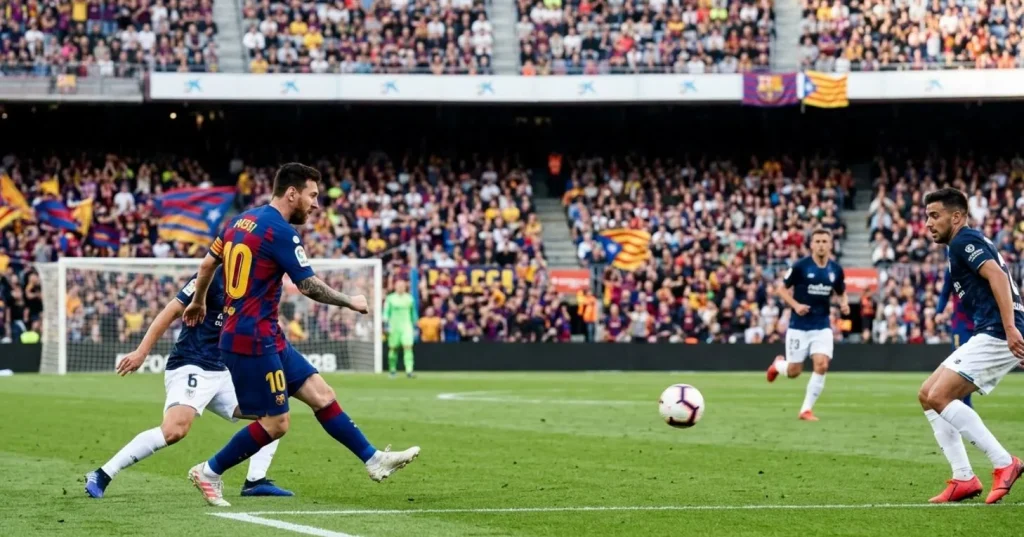
Lionel Messi’s assists record has become a quieter but no less important part of his legacy. Goals made him a global icon, but assists explain why his greatness has always felt wider than finishing alone. Messi did not simply score at a historic rate. He also built attacks, shaped passing lanes, slowed games down, accelerated them again and gave teammates chances that often looked easier than they really were.
The question of how close he is to the all-time top now has a striking answer: by many modern public counts, Messi is already at the summit or sitting right on the edge of it, depending on how different databases classify historical assists. Several recent trackers place him above the 400-assist line, with widely reported figures around 405 career assists after his late-2025 Inter Miami run. That number puts him in direct comparison with Ferenc Puskás, Pelé and other historic creators, although assist records are harder to standardize than goals.
That uncertainty is part of the story. Goals are usually simple to count. Assists are more complicated, especially across eras. Older matches were not always recorded with modern detail. Different competitions have used different definitions. Some lists include only official senior matches. Others count broader appearances or apply modern assist rules to older football. Because of that, Messi’s place at the top should be understood with care: he is either already the all-time assist leader in many recognized modern lists, or close enough that the debate has effectively moved from “can he reach the top?” to “how far can he separate himself?”
The assist record is not one clean scoreboard
The phrase “all-time assists record” sounds simple, but football does not have one universally controlled historical assist table. That is why Messi’s chase is different from a league scoring record or a Champions League milestone. Assists depend on definitions, archival quality and statistical tradition.
In modern football, an assist is usually credited when a player makes the final pass or action before a goal. But even today, details can vary. Does a pass before a deflected finish count? What about a won penalty? A free kick that forces a rebound? A corner that creates chaos before the final touch? Different data providers may answer differently.
The problem becomes larger with older players. Ferenc Puskás and Pelé played in periods when match footage, official databases and assist tracking were not as complete as they are today. Their creative value is beyond doubt, but exact assist totals are reconstructed from available records rather than captured by the kind of live data systems used now.
That is why Messi’s record should be read through three layers:
- The modern-data layer, where his Barcelona, PSG, Inter Miami and Argentina assists are tracked with far greater detail.
- The historical-comparison layer, where his total is measured against legends whose records may be less complete.
- The legacy layer, where the exact number matters, but the style and volume of creation matter just as much.
This makes the assist race more interesting rather than weaker. It reminds readers that playmaking has always been harder to measure than scoring. A brilliant pass can be wasted by a teammate. A simple square ball can become an assist if the finish is excellent. A player can control a match without receiving a statistical reward. Messi’s record stands out because it combines the official-looking number with the eye test: the statistics say he is elite, and the matches show why.
Where Messi stands now
By the middle of 2026, Messi’s career assist total is commonly tracked in the 400-plus range. Several reports from late 2025 credited him with reaching 405 career assists, a figure that placed him above Puskás in widely circulated all-time lists. Since he remained active for Inter Miami and Argentina into 2026, the live total can shift quickly with every match.
That is the safest way to frame the number: Messi has crossed the symbolic 400-assist barrier and is either already first or effectively level with the greatest assist totals ever listed in men’s football. For a player who also ranks among the greatest goalscorers in history, that combination is almost absurd.
The nearest names vary depending on the list, but the usual historic comparison includes Puskás and Pelé. Johan Cruyff, Thomas Müller, Kevin De Bruyne, Luis Suárez and other elite creators often appear in broader conversations, though not always at the same total level. Messi’s advantage is that he did not build his record as a pure supplier. He built it while also being the main scorer, main dribbler and main tactical reference in many of his teams.
A simplified view of the race helps show why the debate is so tight at the very top.
| Player | Commonly cited assist range | Why the comparison matters |
|---|---|---|
| Lionel Messi | 400+ | Modern era’s most complete scorer-creator |
| Ferenc Puskás | Around 400 | Historic benchmark with legendary scoring and creation |
| Pelé | High 300s | All-time great whose records span a less standardized era |
| Johan Cruyff | Mid-to-high 300s | Creative icon who shaped modern attacking football |
| Thomas Müller | 300+ | Elite modern assister built on movement and timing |
The numbers should not be treated as perfectly identical measurements across generations. They are best used as a map of scale. Messi’s total belongs in the highest possible category, and his active status means the gap can still grow.
Why Messi’s assists feel different from ordinary final passes
Some players collect assists mainly through set pieces, crosses or simple passes to elite finishers. Messi has done all of those things, but his assist profile is broader. He can create from a through ball, a diagonal switch, a disguised reverse pass, a low cutback, a dribble that pulls three defenders out of shape, a chipped ball over the line, or a set piece placed into the exact corridor between goalkeeper and defender.
The special part is not only that he passes well. It is when and where he sees the pass. Messi often holds the ball longer than expected, waiting for a defender to shift half a step. He attracts pressure, then releases the ball into the space that pressure has opened. Many of his assists feel like the final visible moment of a move he had already designed several touches earlier.
At Barcelona, this became almost routine. He combined with Xavi, Andrés Iniesta, Dani Alves, Jordi Alba, Neymar, Luis Suárez and many others in patterns that opponents knew were coming but still struggled to stop. The famous left-footed pass into Alba’s run became one of the defining actions of late Barcelona Messi. The combination with Suárez was sharper and more brutal: quick, direct, often ending with a finish before defenders could reset.
With Argentina, the assists carried a different emotional weight. Messi often had to create in tighter, more tense matches where the national team’s rhythm depended heavily on his decisions. His passes in major tournaments became part of Argentina’s attacking identity, especially as the team evolved into a more balanced, resilient side around him.
At Inter Miami, the creative role changed again. The pace is different, the league is different, and the tactical environment is less familiar than Barcelona’s long-built system. Yet Messi still produces assists because his game no longer depends mainly on speed. His advantage is vision, timing and technical control.
The hidden difficulty of staying creative for 20 years
Scoring deep into a career is hard. Creating at an elite level for that long may be even harder. A finisher can sometimes survive with movement, positioning and penalty-box instinct. A creator must still read pressure, receive between lines, understand teammates’ runs and execute passes at the right speed. That requires sharpness, not only experience.
Messi’s assist record is a longevity record in disguise. It shows that his brain has stayed ahead of the game even as his body changed. The teenage winger who dribbled through defenses at Barcelona is not the same player as the veteran playmaker in Miami and Argentina. But the creative thread is continuous.
His career can be read through changing playmaking roles.
- As a young winger, he created by beating defenders and forcing the back line to collapse.
- As a false nine, he created by dropping into midfield and pulling center-backs into impossible choices.
- As a right-sided playmaker, he created by cutting inside and finding runners behind the defense.
- As a senior Argentina leader, he created by controlling tempo and choosing moments more carefully.
- As an Inter Miami veteran, he creates with economy, using fewer explosive actions but still finding decisive passes.
That evolution is central to the record. Many players lose creative influence when they lose acceleration. Messi reduced the physical cost of his game without losing the danger of his left foot. He stopped needing to win every duel in open space because he could win the decision before the duel began.
How close is he to being untouchable?
If the question is whether Messi is close to the all-time top, the answer is that he is already there by many current counts. The more interesting question is whether he can move far enough ahead to make the debate feel settled even across different databases.
A lead of one or two assists over a historic rival is symbolically powerful but statistically fragile. A lead of 15, 20 or 30 becomes harder to dispute. Since Messi is still active, every assist now matters not because he needs to prove himself, but because it strengthens the record against future arguments about counting methods.
The path to a larger gap depends on minutes, health and role. Messi does not need to play every match at full intensity to add assists. He needs enough time on the pitch, teammates making runs and set-piece chances. Inter Miami’s attacking structure gives him opportunities because the team often looks to him as the final decision-maker. Argentina can also add to the total, though international matches are fewer and more physically demanding.
There is also the World Cup factor. If Messi appears at the 2026 tournament, every assist would carry extraordinary historical value. A World Cup assist late in his career would not only increase the total. It would strengthen the feeling that his playmaking survived at the highest emotional level of football.
Why the assists record changes the way Messi is remembered
Messi’s goal record is so huge that it can accidentally hide his passing. That is the unusual problem with his legacy: one historic skill can overshadow another. If he had scored far fewer goals, he might still be remembered as one of the greatest playmakers ever. Because he scored at a rate comparable with the best finishers in history, his assisting sometimes feels like an extra feature rather than a central achievement.
The assist record corrects that view. It proves that Messi was not a scorer who also passed well. He was a complete attacking system. At his peak, he could be the player who started the move, broke the line, made the final pass and finished the next chance himself. Teams were built around that rare combination because it solved problems that normally require several specialists.
This is why comparing Messi with pure playmakers is difficult. He did not spend his whole career as a classic number 10 whose main job was feeding others. He carried scoring responsibility at the same time. His assist total therefore sits beside a huge goal total, creating one of the most balanced attacking profiles football has seen.
The record also explains why many defenders found him so hard to manage. If they stepped toward him, he passed behind them. If they dropped off, he shot. If they doubled him, he found the free man. If they left him isolated, he dribbled. The assist was often the punishment for trying too hard to stop the goal.
The record still has room to grow
Messi’s all-time assist position is already historic, but the final chapter is not closed. At 38, he is no longer the constant runner of his Barcelona prime, yet his passing remains efficient because it depends on technical clarity and anticipation. Players around him still make runs because they know the ball can arrive. Opponents still shift toward him because they know he can decide a match.
The next additions to his total may come in different ways: a through ball in MLS, a corner for Inter Miami, a pass to a late runner for Argentina, a set piece in a major tournament, a simple assist after a move that began with his own touch seconds earlier. None of them needs to be spectacular to matter. Records are built from ordinary-looking actions repeated at extraordinary volume.
The all-time top is no longer a distant target for Messi. It is the space he already occupies, with only the exact margin depending on the counting system. That is what makes the record so powerful. It is not a late-career consolation prize or a statistical curiosity. It is the clearest numerical proof that Messi’s genius was always double-edged: he could end attacks himself, or he could hand the ending to someone else.