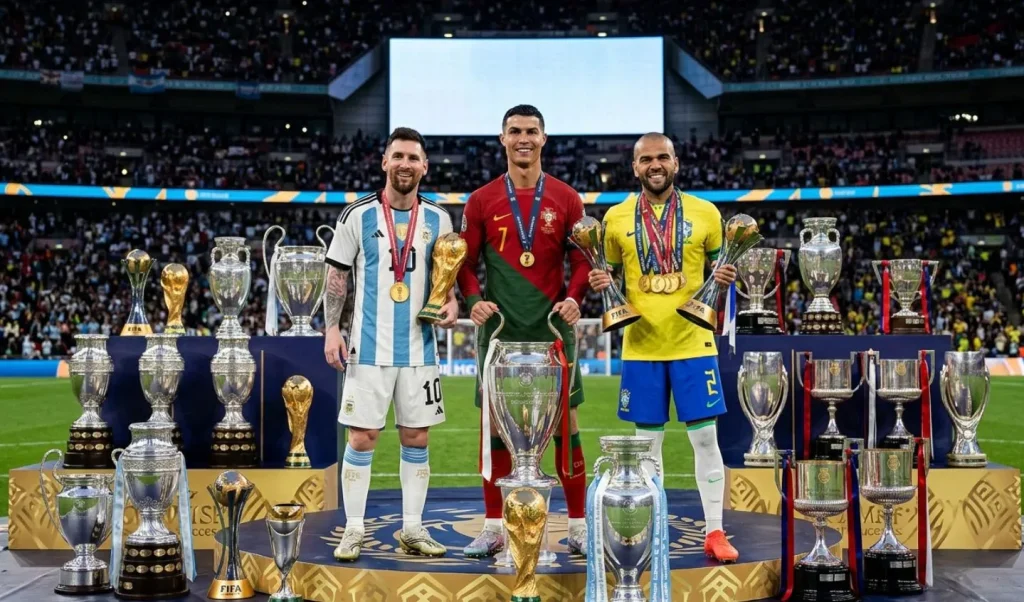
Counting trophies in football sounds easy until the list reaches the very top. A league title is simple. A Champions League medal is simple. A World Cup or Copa América is simple. Then the arguments begin. Should one-match super cups count the same as long league campaigns? Should minor domestic cups be included? What about tournaments won by players who barely featured? What about historical competitions with changing formats? This is why the list of footballers with the most trophies is both fascinating and slightly unstable.
Still, the broad picture is clear. Lionel Messi sits at the top of the modern conversation with the largest medal collection commonly credited to any player in football history. Dani Alves, once widely treated as the record holder, remains close behind. Hossam Hassan, Hossam Ashour, Sergio Busquets, Andrés Iniesta, Gerard Piqué, Maxwell, Ryan Giggs, Cristiano Ronaldo and several other serial winners form the wider group of players whose careers were shaped by repeated success.
The most decorated players are not always the best players in a simple ranking of talent. Trophy totals depend on team strength, era, club choice, national-team opportunity, career length and timing. Yet a huge medal collection still says something powerful: the player spent years inside winning environments and contributed enough to stay there.
Why trophy counts are not all equal
A trophy list can mislead if it is read without context. Winning 40 titles at Barcelona, Real Madrid, Bayern Munich, Manchester United, PSG or Al Ahly is not the same as winning them across weaker teams, and it is not the same as carrying an underdog to rare success. Some players collected trophies as stars. Others were system players, squad leaders, defensive anchors, creative organizers or reliable specialists.
That does not make one path automatically better. It simply means trophy totals should be read with a second question: what was the player’s role in those wins?
Messi’s medal collection is different from a player who mainly accumulated squad trophies from the bench. Alves’ record matters because he was a major attacking full-back across several elite clubs and Brazil. Busquets, Iniesta and Piqué were not just present during Barcelona and Spain’s golden years; they were structural pieces of those teams. Ronaldo’s total is smaller than Messi’s, but it includes league titles in England, Spain and Italy, five Champions League wins and major international success with Portugal.
When comparing medal collections, several details make the difference:
- Longevity, because staying at trophy-winning clubs for 15 or 20 years is rare.
- Starting role, because leading a team carries different weight from being a fringe player.
- Variety, because winning in different leagues or with a national team broadens the achievement.
- Major trophies, because World Cups, continental titles and Champions Leagues shape legacy more than smaller cups.
- Era strength, because some players benefit from dynasties that dominate domestic football for years.
This is why the “most trophies” debate works best as a layered discussion. The total number opens the door, but the meaning comes from the career behind it.
The leading medal collectors
The exact order can vary slightly depending on counting rules, especially with super cups, youth titles and older domestic competitions. The following ranking reflects the most commonly cited senior team trophy totals in modern public lists, with the important reminder that some sources may differ by one or two medals.
| Player | Commonly cited trophy total | Main winning teams | Career profile |
|---|---|---|---|
| Lionel Messi | 47 | Barcelona, PSG, Inter Miami, Argentina | Record leader, scorer-creator, World Cup winner |
| Dani Alves | 44 | Barcelona, PSG, Sevilla, Juventus, Brazil | Elite full-back, serial winner across clubs |
| Hossam Hassan | 41 | Al Ahly, Zamalek, Egypt | Egyptian icon with huge domestic and national success |
| Hossam Ashour | 39 | Al Ahly | Midfield mainstay in one of Africa’s great dynasties |
| Sergio Busquets | 38 | Barcelona, Spain, Inter Miami | Tactical anchor of dominant club and national sides |
| Andrés Iniesta | 37 | Barcelona, Spain, Vissel Kobe | Big-game midfielder and World Cup final hero |
| Gerard Piqué | 37 | Manchester United, Barcelona, Spain | Defender in two major club eras and Spain’s peak |
| Maxwell | 37 | Ajax, Inter, Barcelona, PSG | Understated defender with medals across top clubs |
| Ryan Giggs | 36 | Manchester United | One-club Premier League and European great |
| Cristiano Ronaldo | 35 | Manchester United, Real Madrid, Juventus, Portugal, Al Nassr | Champions League icon and multi-league winner |
The table shows how different the routes can be. Messi’s list is built around Barcelona’s dominance, Argentina’s late golden run, PSG’s domestic titles and Inter Miami’s rise. Alves’ count reflects a career of moving through elite sides at the right time while still playing a real role. Hossam Hassan and Hossam Ashour remind global fans that trophy dominance is not only a European story. Busquets, Iniesta and Piqué show how one golden club-and-country generation can fill an entire cabinet.
Messi at the top: why his collection feels complete
Messi’s trophy record carries special weight because it includes almost every type of achievement a footballer can realistically target. He won league titles, domestic cups, domestic super cups, Champions League trophies, Club World Cups, Copa América titles, the Finalissima and the World Cup. For years, the only common argument against the completeness of his medal collection was the missing senior World Cup. Once Argentina won in Qatar in 2022, that gap disappeared.
What makes Messi’s trophy haul unusual is the combination of volume and centrality. He was not a passenger in Barcelona’s greatest period. He was the decisive attacker, the player around whom the team increasingly revolved. He was not a symbolic veteran for Argentina in 2021 and 2022. He was the captain, creator, scorer and emotional center of the side.
The Inter Miami chapter added a different note. The trophies there do not carry the same historical weight as a Champions League or World Cup, but they extended the record and showed how Messi could still change the ambition of a club outside Europe. That matters because late-career trophies often reveal whether a player remains influential or simply present.
Messi’s medal collection is therefore not only the largest. It is balanced: club dominance, international redemption, domestic consistency, continental success and late-career expansion.
Dani Alves and the full-back who changed the record race
Before Messi moved clear, Dani Alves was the name most often attached to the “most decorated footballer” label. His career is a reminder that defenders and full-backs can shape trophy history just as strongly as forwards. Alves was not a cautious right-back collecting medals from the edge of the team. At Sevilla and Barcelona, he was a constant source of width, passing, crossing, pressing and attacking rhythm.
His Barcelona years created the core of his trophy count, but they were not the entire story. Sevilla gave him European recognition, Juventus added an Italian chapter, PSG added French titles, and Brazil contributed international trophies. Alves’ medal collection fits his playing personality: restless, attacking, bold and always close to the action.
His case also helps explain why trophy totals should not be reduced to glamour positions. Full-backs, holding midfielders and center-backs often appear high on these lists because they provide stability across long periods. Coaches trust them. Teams keep them. Winning cycles continue around them.
The Barcelona and Spain cluster
One of the most striking features of the all-time trophy list is how many names are tied to Barcelona and Spain’s golden era. Busquets, Iniesta, Piqué, Messi and Alves all benefited from the same club dynasty, while Busquets, Iniesta and Piqué also formed part of Spain’s extraordinary international run.
This was not luck alone. That generation played a style that allowed dominance to repeat: possession control, positional intelligence, pressing after loss and technical superiority under pressure. Players inside that system did not just win once. They kept winning because the model was stable and the squad had leaders in every line.
The Barcelona-Spain core shows how trophies multiply when club and national-team cycles overlap. A player can win La Liga, Copa del Rey, Champions League, Spanish Super Cup, UEFA Super Cup and Club World Cup with his club, then add European Championships and World Cups with his country. When those cycles run together, medal totals climb quickly.
The same principle explains other names on the list. Ryan Giggs’ total grew because Manchester United dominated English football for two decades. Hossam Ashour’s count reflects Al Ahly’s repeated domestic and continental success. Maxwell’s career moved through clubs that were often built to win immediately.
Ronaldo’s lower total and higher weight
Cristiano Ronaldo is not at the top of the trophy-count table, which can surprise casual fans. His individual records are enormous, his Champions League legacy is arguably unmatched, and his career has crossed several major leagues. Yet his medal total is usually listed below Messi, Alves, Busquets, Iniesta and others.
That does not weaken Ronaldo’s place in football history. It simply shows that trophy count is only one way to measure a career. Ronaldo’s collection has enormous weight: five Champions League titles, league titles in England, Spain and Italy, a European Championship and Nations League success with Portugal. Few players can match that spread.
His trophy list is especially strong in premium competitions. The five Champions League medals matter deeply because they came during an era when the tournament defined elite club status. His Euro 2016 triumph with Portugal also changed the international part of his legacy. Portugal had never won a major senior international trophy before that tournament.
Ronaldo’s case is a useful warning against lazy trophy comparisons. A player with 35 major senior trophies can have a stronger historical profile than someone with more medals but less influence, weaker competitions or fewer decisive roles. The medal cabinet matters, but it does not replace performance, records or context.
Medal collections and the problem of timing
Many great footballers never approach these totals because their timing was different. They may have played for clubs in transition, national teams without golden generations, or leagues where titles were spread more evenly. Some players were loyal to one club during a period when that club did not dominate. Others played before the modern calendar created so many trophy opportunities.
Timing can turn an excellent career into a record-breaking medal collection. A player joining Barcelona in 2008, Real Madrid in 2014, Manchester United in the 1990s, PSG during its domestic dominance or Al Ahly during a continental peak had more chances than a player of equal quality at a less dominant club.
This is not unfair; it is part of football. Great teams still need great players. But it explains why trophy records often group around dynasties. Medals are team achievements attached to individual names.
A fair reading of the biggest collections should keep three categories separate:
- Players who were central stars of winning teams, such as Messi, Ronaldo, Alves, Iniesta and Busquets.
- Players who were long-serving pillars of dominant institutions, such as Giggs, Ashour and Piqué.
- Players whose careers were especially well-timed across several strong clubs, such as Maxwell.
These categories can overlap. Messi was both central star and long-serving pillar. Alves was both star and well-timed elite traveler. Giggs was both pillar and regular contributor across eras. The point is not to reduce the players, but to understand why their medal totals became so large.
What the biggest trophy collections really prove
The players with the most trophies in football history prove something broader than simple winning. They show how hard it is to remain useful inside successful teams. Big clubs replace players quickly. National teams move through generations. Coaches change systems. Younger talent arrives. Injuries interrupt careers. Motivation fades. To keep collecting medals, a player must either remain exceptional or remain trusted.
That trust is the hidden thread connecting the list. Messi was trusted to decide matches. Alves was trusted to attack from defense. Busquets was trusted to control space. Iniesta was trusted with the ball under pressure. Piqué was trusted to lead the back line. Giggs was trusted across multiple tactical eras. Ronaldo was trusted to deliver in the biggest scoring moments.
Trophy totals should not be worshipped blindly, but they should not be dismissed either. A huge collection usually means the player repeatedly survived elite standards. He kept his place in dressing rooms where winning was expected, not celebrated as a miracle.
A record table that will keep moving
Messi’s lead is strong, but trophy records are not frozen. Active players can still climb, especially those at dominant clubs or with powerful national teams. Modern schedules offer many chances: league titles, domestic cups, continental competitions, super cups, international tournaments and expanding global events. A player who stays fit in the right environment can add several medals in one year.
Still, reaching the very top is becoming harder in another way. Careers are longer, but squad rotation is deeper and elite competition is more physically demanding. Players may win more trophies collectively, yet fewer remain central for 15 straight years. The record holders combined talent, durability, timing and team dominance in rare proportions.
The phrase “most trophies in football history” can never explain everything by itself. It needs context, weight and role. But the names at the top are not accidental. Messi, Alves, Busquets, Iniesta, Piqué, Giggs, Ronaldo and the Egyptian legends built careers inside winning habits that lasted far beyond one good season.
A medal collection does not tell the whole story of greatness. It tells the story of repeated presence at the end of successful campaigns. In football, where so much can collapse through one injury, one mistake or one bad season, that kind of repetition is its own achievement.