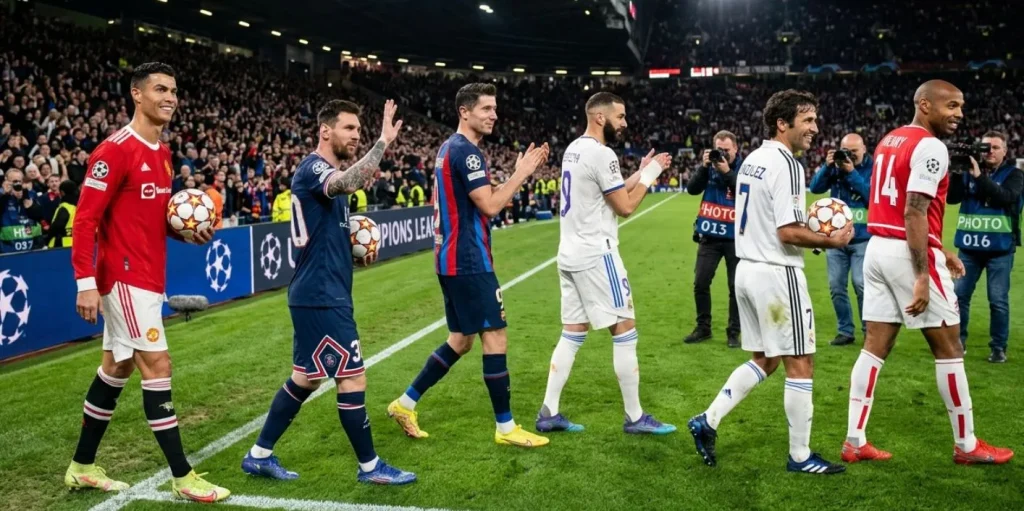
The Champions League all-time top scorers list is more than a ranking of great finishers. It is a map of modern European football: the rise of the group stage, the dominance of Real Madrid and Barcelona, the evolution of the elite striker, and the way one competition became the biggest personal stage for the world’s best attackers. Goals in domestic leagues can be built over long seasons, but Champions League goals arrive under a different light. The opponents are stronger, the margins are smaller, and the pressure grows heavier from the first knockout night onward.
Cristiano Ronaldo still stands above everyone with 140 Champions League goals. Lionel Messi follows with 129, while Robert Lewandowski is clear in third after joining the exclusive group of players with more than 100 goals in the competition. Karim Benzema, Raúl, Kylian Mbappé, Erling Haaland, Thomas Müller, Ruud van Nistelrooy, Harry Kane, Thierry Henry and Mohamed Salah complete the wider picture of a list shaped by longevity, finishing quality and repeated appearances at the highest level.
What makes the ranking fascinating is not only the order. It is the distance between the names. Ronaldo and Messi created a two-man summit that may take years to challenge. Lewandowski built a separate tier of his own. Benzema represents the elite second wave. Mbappé and Haaland bring the question of the future: can the next generation turn today’s numbers into a serious pursuit of the top?
The top of the list is harder to reach than it looks
At first glance, the Champions League scoring table seems simple: play enough matches, score enough goals, climb the ranking. In reality, very few players ever get the full combination required. A footballer needs to play for clubs that qualify regularly, stay fit across many seasons, survive tactical changes, perform against elite defenses and deliver in matches where chances are limited.
That is why the gap at the top matters. Ronaldo’s 140 is not just a total; it is the product of 183 appearances, repeated deep runs with Manchester United, Real Madrid and Juventus, and a peak period at Madrid where he turned knockout football into his personal territory. Messi’s 129 came mostly with Barcelona, where he became the most prolific single-club scorer in Champions League history before adding more at Paris Saint-Germain. Lewandowski’s 109 reflects consistency across Borussia Dortmund, Bayern Munich and Barcelona.
The upper table gives a quick view of the modern hierarchy.
| Rank | Player | Goals | Main Champions League clubs |
|---|---|---|---|
| 1 | Cristiano Ronaldo | 140 | Manchester United, Real Madrid, Juventus |
| 2 | Lionel Messi | 129 | Barcelona, Paris Saint-Germain |
| 3 | Robert Lewandowski | 109 | Borussia Dortmund, Bayern Munich, Barcelona |
| 4 | Karim Benzema | 90 | Lyon, Real Madrid |
| 5 | Raúl | 71 | Real Madrid, Schalke |
| 6 | Kylian Mbappé | 70 | Monaco, Paris Saint-Germain, Real Madrid |
| 7 | Erling Haaland | 57 | Salzburg, Borussia Dortmund, Manchester City |
| 7 | Thomas Müller | 57 | Bayern Munich |
| 9 | Ruud van Nistelrooy | 56 | PSV, Manchester United, Real Madrid |
| 10 | Harry Kane | 54 | Tottenham, Bayern Munich |
| 11 | Thierry Henry | 50 | Monaco, Arsenal, Barcelona |
| 11 | Mohamed Salah | 50 | Basel, Roma, Liverpool |
This ranking also shows how different paths can lead to the same table. Müller reached his total as a space-finder and team-system specialist. Van Nistelrooy was a pure penalty-box predator. Henry blended speed, elegance and finishing. Salah became Liverpool’s leading European attacker from the right side. Kane arrived in the top ten through efficiency, penalty-area intelligence and a strong Bayern chapter.
Ronaldo and Messi built the unreachable summit
The reason Ronaldo and Messi remain the reference points is not only that they are first and second. It is that they turned Champions League scoring into a long-term rivalry within the competition itself. For more than a decade, they made huge European totals feel normal. A group-stage goal, a knockout brace, a hat-trick, a final goal, a scoring record — every season seemed to add another layer.
Ronaldo’s Champions League identity became inseparable from Real Madrid’s European dominance. He scored in finals, destroyed elite opponents in knockout ties and produced his best volume when the tournament became most demanding. His 17-goal season in 2013/14 remains the single-campaign benchmark, and his ability to repeatedly decide quarter-finals, semi-finals and finals is the strongest part of his European case.
Messi’s record has a different shape. He was not only a finisher. He was often the player who carried the ball into danger, created the chance and still finished it himself. His Barcelona years gave the competition some of its most memorable attacking displays: curling shots, disguised finishes, dribbles through crowded areas and combinations that looked rehearsed until he improvised something impossible.
The contrast between them gives the top of the list its character. Ronaldo’s Champions League image is direct, explosive and ruthless in the box. Messi’s is fluid, creative and devastating through control. Both reached totals that would have seemed unrealistic before their era.
Their distance from the rest of the field means the next challenger does not simply need talent. He needs a decade of Champions League presence, a high-scoring club environment, injury luck and the ability to keep producing after defenders have studied every habit.
Lewandowski and Benzema define the elite striker tier
Robert Lewandowski’s place in third is especially important because he is the only player outside Ronaldo and Messi to cross 100 Champions League goals. That puts him in a rare middle ground: not quite level with the two giants, but clearly above almost everyone else.
Lewandowski’s record is built on repetition and technical cleanliness. He rarely needed five touches when one would do. He scored with both feet, his head, penalties, first-time finishes, turns inside the box and classic striker movements between center-backs. His Bayern years were the core of the total, but his Dortmund and Barcelona goals prove that the record was not dependent on one team alone.
Benzema’s 90 goals tell a different story. For years, he was not always treated as the main statistical star at Real Madrid because Ronaldo absorbed the spotlight. Yet Benzema’s Champions League career aged into something exceptional. His 2021/22 campaign, full of decisive knockout goals, changed the tone of his European legacy. He moved from elite support forward to main-stage match-winner.
A useful way to separate the top forwards is to look at the kind of scoring value they gave their teams:
- Ronaldo offered knockout dominance, aerial threat, penalty-box aggression and record-breaking volume.
- Messi added goals from open play, dribbling creation, set pieces and impossible angles.
- Lewandowski brought classic striker efficiency, movement and finishing consistency.
- Benzema combined link-up play with late-career decisive scoring.
- Raúl gave Real Madrid an early Champions League-era reference point before the modern scoring explosion.
These profiles matter because the top scorers list is not filled with identical players. The competition has rewarded different versions of greatness: the winger who became a striker, the creator who scored like a forward, the number nine, the hybrid forward and the intelligent space interpreter.
Why the modern era changed the numbers
The Champions League did not always give players the same number of matches. The old European Cup was more compact, with fewer games and less room for giant seasonal totals. Modern Champions League football expanded the calendar through group stages, then more fixtures, and eventually a broader league-phase format. More matches create more chances to score, especially for players at clubs that regularly reach the later rounds.
This is why older names can look lower than their influence suggests. Alfredo Di Stéfano, Eusébio and other European Cup legends played in a different structure. Their totals were built in fewer games, often in straight knockout conditions where one bad tie could end the season. Modern players have had more opportunities, but they also face deeper analysis, more tactical preparation and enormous physical demands.
The list therefore needs two readings. One reading is numerical: Ronaldo leads, Messi follows, Lewandowski is third. The other reading is historical: modern totals are shaped by the tournament format, club dominance and fixture volume.
That does not reduce the achievement. Scoring 140 Champions League goals still requires extraordinary output. It simply explains why the top of the list is dominated by players from the Champions League era rather than the early European Cup years.
The active challengers: Mbappé, Haaland, Kane and Salah
The most interesting part of the current list sits below the retired or almost-finished legends. Kylian Mbappé, Erling Haaland and Harry Kane are still adding to their totals, while Mohamed Salah remains a major modern name after reaching the 50-goal mark. Their chances of climbing depend on age, club level, fitness and how often their teams reach the deepest rounds.
Mbappé is already in the top six with 70 goals. His move into a Real Madrid environment gives him a platform that historically supports Champions League scoring. He has pace, penalty-area instinct, one-v-one threat and experience from major knockout matches. If he stays fit and Madrid remain regular contenders, he has the clearest path toward the 100-goal club.
Haaland’s case is different because his goals-per-game rate is extraordinary. He reached elite Champions League numbers faster than anyone expected, and his direct style suits a team that creates high-quality chances. The question with Haaland is not scoring ability. It is longevity in the competition. To chase Ronaldo or Messi, he needs many years of availability and deep campaigns.
Kane’s total reflects a player who reached the top ten without spending his entire prime at a Champions League superclub. His Bayern move increased his opportunity, and his finishing style travels well: penalties, headers, quick shots, link play and intelligent positioning. Salah’s record is built around Liverpool’s modern European rise, especially his reliability from the right channel and his ability to score in high-pressure matches.
For the active challengers, the route upward can be summarized in three conditions:
- They must stay at clubs capable of reaching quarter-finals, semi-finals and finals.
- They must avoid long injury absences during peak scoring years.
- They must keep penalty-box roles even as tactics and teammates change.
- They must add goals in knockout rounds, where the historical weight is greatest.
- They must produce across several seasons, not only in one explosive campaign.
This is why catching Ronaldo is so difficult. It is not enough to score 15 goals once. A player has to stack strong seasons repeatedly and still be there when the biggest matches arrive.
What the list says about Champions League greatness
The all-time top scorers list does not measure every kind of football greatness. Midfielders, defenders and goalkeepers shape Champions League history in ways that do not appear here. Even among attackers, assists, pressing, movement and leadership can be hidden by goal totals. Still, the list captures something essential: who consistently turned Europe’s hardest club matches into scoring opportunities.
Ronaldo’s lead shows the value of obsession and knockout authority. Messi’s total shows the power of a player who could create and finish at once. Lewandowski proves that a classic center-forward can survive tactical eras if the movement and technique are sharp enough. Benzema shows that a player’s European legacy can grow dramatically in the later stages of a career. Mbappé and Haaland remind fans that the list is still alive.
The beauty of the ranking is that it creates arguments without needing artificial drama. Who had the greatest peak? Who scored the hardest goals? Who benefited most from team dominance? Who was most efficient? Who can still climb? The numbers start the debate, but they do not end it.
The record that still belongs to Ronaldo
For now, the Champions League scoring crown still belongs to Cristiano Ronaldo. Messi is close enough to make the rivalry permanent, but not close enough to change the order. Lewandowski has built a historic third-place record, yet even his century leaves him well short of the top two. Benzema and Raúl remain giants of their eras. Mbappé and Haaland are the future threats, but their chase is measured in years, not months.
That is what makes the list powerful. It rewards brilliance, but it punishes interruption. One injury-hit season, one club outside the competition, one tactical change or one early exit can slow a player’s rise. The players at the top avoided enough of those obstacles to turn talent into accumulation.
The Champions League all-time top scorers table will keep changing below the summit. Mbappé can climb. Haaland can surge. Kane can move higher. Salah may still add to his total. But the first two names remain the defining frame of the modern competition: Ronaldo, then Messi, with everyone else chasing not only goals, but an era that changed the scale of European scoring.