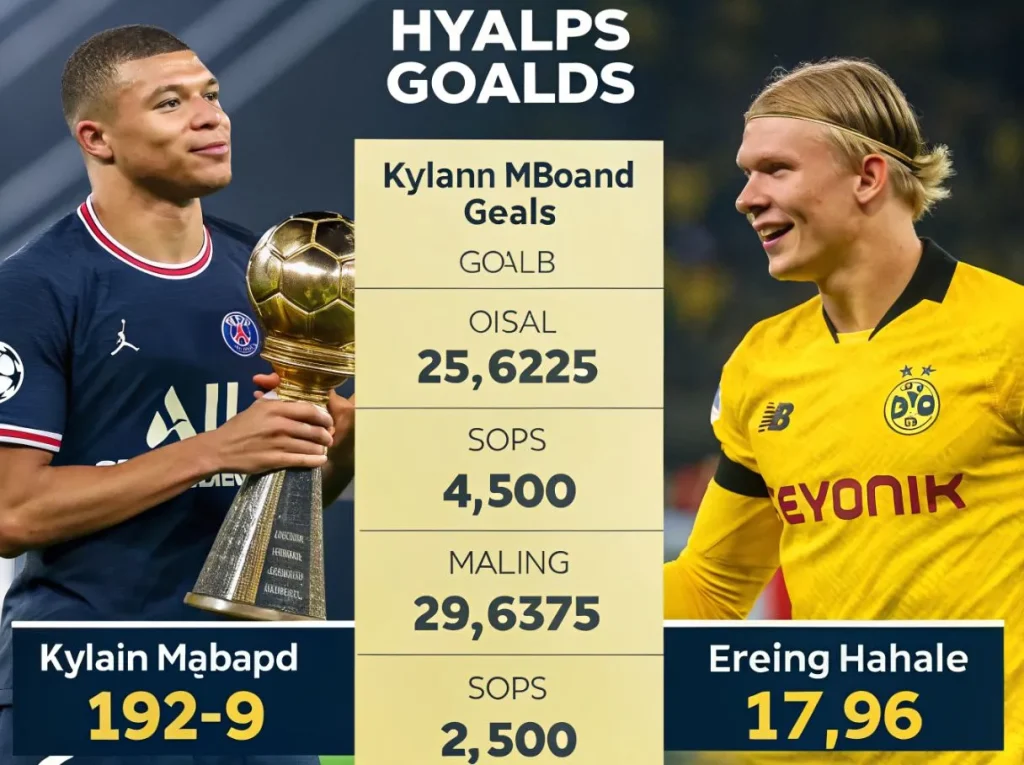
Kylian Mbappé and Erling Haaland have become the simplest shorthand for football’s next great individual rivalry, even though they are not mirror images of each other. One is a French forward raised in the language of acceleration, wide spaces, World Cup pressure and one-versus-one devastation. The other is a Norwegian striker built around penalty-box violence, timing, physical power and an almost mechanical relationship with goals.
That difference is exactly why the comparison works. Mbappé and Haaland are not competing by copying the same model. They are offering two versions of modern attacking greatness. Mbappé can start wide, receive on the run, isolate defenders and turn a match into a sprinting problem. Haaland can spend long spells away from the ball, then decide the game with one movement across a defender’s shoulder. Mbappé often looks like the attack’s ignition. Haaland often looks like its final explosion.
By 2026, both have already built careers that most forwards would accept as complete. Mbappé has passed 400 senior goals for club and country, won the World Cup with France, played in another World Cup final and collected a long list of domestic trophies. Haaland has moved beyond 340 senior goals, won the Champions League with Manchester City, dominated Premier League scoring charts and reached absurd efficiency levels before turning 26. The debate is no longer about whether they are elite. It is about which kind of elite player is easier to build around, which record path looks stronger, and which career will age better.
The comparison begins with age and route, not only goals
Mbappé is older by a little under two years, and that matters when reading the totals. He broke through at Monaco, became a superstar at Paris Saint-Germain, moved to Real Madrid and became France’s attacking reference point while still very young. His career has been played under constant national and global attention. The 2018 World Cup turned him from a teenage phenomenon into a world champion before he had even reached his early twenties.
Haaland’s path was more vertical. Molde, Salzburg, Dortmund and Manchester City each sharpened a different part of his profile. At Salzburg, he became a European scoring shock. At Dortmund, he proved the numbers were not a short-term spike. At City, he entered a possession machine and gave it a pure finishing weapon. His rise has felt less theatrical than Mbappé’s, but the scoring speed has been brutal.
A fair comparison has to start with role. Mbappé has often played as a left-sided forward, central striker, second forward and transition leader. Haaland is more clearly a center-forward. That means Mbappé may naturally collect more carries, dribbles, wide combinations and assists, while Haaland may naturally produce a cleaner goals-per-game profile because his game is focused closer to goal.
Their careers are not two identical tests with different scores. They are two different exams.
Goals: volume against efficiency
Mbappé currently leads in total senior goals because he has played more matches and has been in elite first-team football slightly longer. His total above 400 reflects longevity at a young age, domestic dominance in France, strong Champions League output, Real Madrid production and a major international record with France. He scores in different ways: right-foot finishes from the left channel, near-post shots, penalties, cutbacks, counterattacks, one-touch finishes and bursts into space.
Haaland trails in total volume but closes the gap through rate. His career total above 340 goals is staggering because it has come in fewer matches. He does not need many touches to affect the scoreboard. Some matches make him look quiet until the moment he separates from a defender, attacks the six-yard box or finishes a low cross before the goalkeeper can set his feet.
A simple numerical snapshot shows the contrast.
| Category | Kylian Mbappé | Erling Haaland |
|---|---|---|
| Age in 2026 | 27 | 25 |
| Senior career goals | 400+ | 340+ |
| Senior career assists | 120+ | 60+ |
| International goals | 56 for France | 55 for Norway |
| Main club in 2026 | Real Madrid | Manchester City |
| Champions League best scorer season | 15 goals in 2025/26 | 12 goals in 2022/23 |
| Main scoring pattern | Speed, angles, isolation, transition | Box movement, power, first-time finishing |
The table explains why fan arguments often go in circles. Mbappé brings more all-round attacking actions and a broader creative profile. Haaland brings a more concentrated scoring identity. If a team needs a forward to carry the ball 40 meters and break the shape of the match, Mbappé is the more natural answer. If a team already creates high-quality chances and needs the most ruthless final touch possible, Haaland may be the cleaner fit.
Trophies: Mbappé has the World Cup, Haaland has the Champions League
The trophy comparison is not only about counting medals. It is about the type of medal that defines each player’s story. Mbappé’s greatest advantage is obvious: he has a World Cup. Not as a squad passenger, not as a late substitute, but as a major attacking figure. He scored in the 2018 final, then produced a hat-trick in the 2022 final and won the tournament’s Golden Boot. That gives his international legacy a weight Haaland cannot yet match.
Haaland’s strongest club argument is just as clear: he has the Champions League with Manchester City. The 2022/23 treble season gave him the European title that Mbappé chased for years at PSG and still seeks at Real Madrid. Haaland was not at his sharpest in every knockout moment, but his presence changed how opponents defended City, and his scoring across the campaign helped push the team through the season’s hardest demands.
Mbappé’s club trophy list is longer because of PSG’s domestic dominance and Monaco’s Ligue 1 title. Haaland’s list is shorter but includes the Champions League, Premier League titles, FA Cups, the Club World Cup and trophies in Austria and Germany. Mbappé owns the bigger international medal. Haaland owns the bigger club medal.
That contrast gives the rivalry a clean tension. Mbappé needs the Champions League to complete the strongest possible club argument. Haaland needs a major international tournament, or at least a deeper Norway story, to close the emotional gap in national-team legacy.
Playing style: speed against gravity
Mbappé changes the geometry of a pitch. Defenders cannot hold a high line against him without risk. Full-backs hesitate before stepping forward. Center-backs open their shoulders early because they fear the run behind. Even when he does not receive the ball, his speed stretches the defensive block and creates space for others.
His most dangerous zones are the left channel, the space between full-back and center-back, and transition moments where the back line is not set. He can finish like a striker, but his threat often begins before the penalty area. He wants the defender facing his own goal. He wants open grass. He wants one touch to push the ball beyond the first challenge.
Haaland’s style is different. He does not need to dominate the ball to dominate the match. His danger sits in the timing of the last movement. He waits between defenders, bends runs, attacks blind sides and arrives in the zone where a chance becomes almost impossible to miss. His size makes him a target, but his movement is more important than his height. He is not simply big. He is early, then late, then suddenly free.
Their best qualities can be separated clearly:
- Mbappé is stronger in open-field attacks, wide isolation, carrying the ball and creating panic before the shot.
- Haaland is stronger in central box occupation, one-touch finishing, aerial threat and converting repeated service.
- Mbappé offers more natural variety between creator and scorer.
- Haaland offers more pure penalty-area certainty.
- Mbappé can rescue a broken attack by dribbling.
- Haaland can make a perfect team move feel inevitable by finishing it.
This is why their styles produce different tactical needs. Mbappé benefits from space, runners around him and fast switches. Haaland benefits from service, width, cutbacks and midfielders who can find him before the defensive line resets.
What each player gives a team without scoring
The deeper comparison begins when neither scores. Mbappé can still tilt a match by forcing defensive retreat. His carrying, decoy runs and ability to receive wide can create room for midfielders and opposite-side attackers. Even on quiet scoring nights, he may change the opponent’s defensive height.
He can also assist at a high level. His career assist total is far above Haaland’s, partly because of role, partly because of style. Mbappé often enters zones where he must decide between shooting and passing. When he draws defenders toward him, the square ball or cutback becomes available.
Haaland’s off-ball value is more subtle. He pins center-backs. He creates space for attacking midfielders because defenders stay aware of his run behind them. He makes crosses and through balls feel more dangerous, even when he does not touch them. A team with Haaland can attack the box earlier because it knows someone will arrive with conviction.
The difference is that Mbappé gives visible involvement. Haaland gives structural fear. One is seen more often in the move. The other can be invisible until the move ends.
Big games and pressure
Mbappé’s big-game case is built heavily on international football. Few modern forwards have created as many defining World Cup moments before 30. The 2018 final goal, the 2022 final hat-trick, the Golden Boot, and his role as France captain all give him a rare profile. He has already lived through the highest-pressure football match in the world twice.
Haaland’s biggest collective moment is Manchester City’s Champions League and treble season. His critics sometimes point to quieter finals or knockout matches, but this can be too simple. Strikers in dominant teams can affect games by occupying defenders, and knockout football often becomes tactical rather than expressive. Still, if Haaland wants to build a Ronaldo-style European legacy, he will need more decisive late-round Champions League moments.
Mbappé also needs a Champions League breakthrough. His numbers in the competition are strong, but the trophy remains a missing piece. Real Madrid gives him the perfect stage to change that. If he wins the Champions League as a major figure, the balance of the comparison shifts heavily toward completeness.
Who is easier to build around?
A club choosing between the two would not only compare goals. It would compare squad structure.
Mbappé is easier to build around if the team wants a flexible forward who can play from the left, lead transitions, combine with other attackers and create his own shot. He may require tactical balance behind him, especially if he is given freedom from wide areas, but he gives a coach more attacking shapes.
Haaland is easier to build around if the team already has creators and wants a central finisher who turns possession into goals. He does not need the system to give him constant touches. He needs the system to give him the right touches. That makes him devastating in a team like Manchester City, where wide players, midfielders and full-backs can feed the box repeatedly.
The practical choice depends on the team’s problem.
- If a team lacks speed and individual ball-carrying, Mbappé solves more problems.
- If a team creates chances but lacks a ruthless finisher, Haaland is closer to the ideal solution.
- If a team plays transition football, Mbappé has the more natural profile.
- If a team controls territory and attacks low blocks with crosses and cutbacks, Haaland becomes terrifying.
- If a team needs both goals and creative burden from one superstar, Mbappé offers more range.
- If a team wants maximum shot conversion inside the box, Haaland is the sharper weapon.
This is the fairest way to compare them. Not by forcing one winner in every category, but by asking which player fits which football problem.
The future of the rivalry
Mbappé and Haaland are still young enough for the comparison to change. Mbappé can add Champions League titles, Ballon d’Or-level seasons at Real Madrid and more World Cup history. Haaland can keep breaking scoring-rate records, win more European trophies and take Norway into tournaments where his international numbers gain wider emotional weight.
Their careers may also age differently. Mbappé’s game has depended heavily on speed, but he has enough technique and finishing intelligence to move more centrally over time. Haaland’s game depends less on dribbling speed and more on movement, size and finishing, which may age well if he stays fit. Both will need adaptation, because every great forward eventually loses something physically and must replace it with timing, positioning or decision-making.
For now, the comparison has no single final answer. Mbappé has the broader attacking palette and the stronger international story. Haaland has the purer goal machine profile and the Champions League medal Mbappé still wants. Mbappé feels like a forward who can bend the match toward himself. Haaland feels like a striker who turns the work of an entire team into the final number on the scoreboard.
That is why the debate will last. They are not fighting for the same identity. They are testing two routes to dominance: the explosive all-round superstar and the most efficient center-forward of his generation. Football is lucky that both routes are still unfolding.