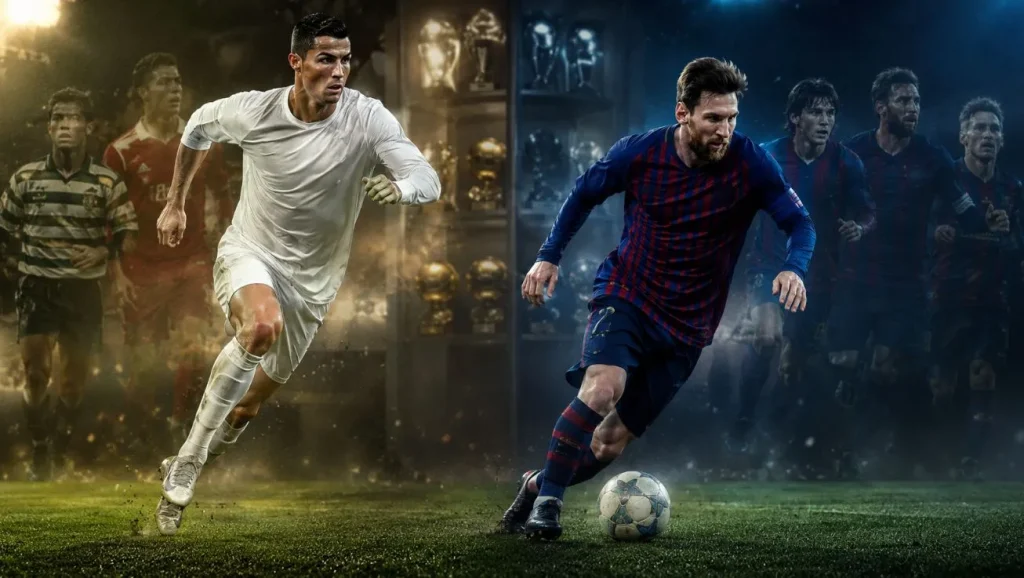
Cristiano Ronaldo and Lionel Messi are usually compared through numbers first, but the deeper difference between them was always visible before the statistics became absurd. Ronaldo looked like a player trying to conquer football through force, repetition, ambition and physical expansion. Messi looked like a player who understood the game half a second earlier than everyone else and bent it with small touches, body angles and timing.
Their rivalry lasted so long that it stopped being a simple argument about who was better. It became a way to describe two opposite routes to greatness. Ronaldo turned himself from a winger into the most relentless scorer of his generation. Messi moved from a dribbling prodigy into a false nine, then into a creator, controller and late-career playmaker who still scores often enough to distort normal comparisons.
By 2026, both careers have passed the point where one match, one tournament or one season can rewrite the entire story. Ronaldo has climbed beyond 970 senior career goals and remains the leading men’s international scorer with Portugal. Messi has crossed the 900-goal mark, while also building one of the largest assist totals ever recorded and completing the international part of his legacy with Argentina. Their records now work less like evidence in a debate and more like monuments to two different football languages.
Two starting points, two football instincts
Ronaldo’s early career at Sporting CP and Manchester United was built on flair, speed and theatrical confidence. He wanted to face defenders, beat them, draw fouls, shoot from distance and make the match feel like a personal duel. The teenage Ronaldo was not yet the ruthless finisher people remember from Real Madrid. He was a wide player full of tricks, stepovers, acceleration and impatience.
Messi’s early rise at Barcelona felt quieter in personality but more radical in football terms. He was small, left-footed, close to the ground and almost impossible to knock out of rhythm. His dribbling was not decorative. He carried the ball as if it were attached to his foot, changing direction without losing control. From the beginning, Messi looked less interested in showing a trick than in escaping pressure with the shortest possible movement.
That difference shaped everything that followed. Ronaldo’s game grew outward: more muscle, more shooting power, more aerial strength, more penalty-box aggression. Messi’s game grew inward: better timing, better passing angles, better control of tempo, better understanding of when to slow down and when to cut through the match.
A simple comparison of their early instincts explains why their careers evolved in such different ways:
- Ronaldo attacked defenders with visible force, speed and repetition.
- Messi manipulated defenders with body shape, balance and timing.
- Ronaldo’s game pushed toward finishing as the final identity.
- Messi’s game expanded toward control, creation and finishing together.
- Ronaldo became more central as he aged.
- Messi became more selective, often moving deeper to remain decisive.
This is why the rivalry never felt like a comparison between identical players. They were not two versions of the same superstar. They were two different solutions to the same problem: how can one player dominate elite football for longer than anyone expects?
Goals: volume, efficiency and the meaning of scoring
Ronaldo leads Messi in total career goals, and that lead matters. His numbers are the product of extraordinary longevity and an unmatched hunger for scoring. He became Real Madrid’s all-time top scorer, the Champions League’s record scorer and the leading scorer in men’s international football. He also kept scoring after leaving Europe, extending his career total deep into his forties.
The impressive part is not only the total. It is the range of scoring methods. Ronaldo has scored with both feet, from penalties, free kicks, headers, long shots, rebounds, counterattacks and close-range finishes. He turned heading into a major weapon, which separated him from most wide forwards of his era. He also developed one of football’s strongest penalty-box instincts: the ability to arrive at the right space before the defender had fully understood the danger.
Messi’s goal record has a different texture. He is behind Ronaldo in total volume, but his scoring has always carried a sense of invention. He scored from dribbles, curled finishes, chipped shots, low passes into the corner, free kicks, central runs, false-nine movements and short combinations around the box. Messi often made goals look less like finishing actions and more like the natural end of a move he had designed himself.
The numbers show the scale, but the style explains the emotional difference.
| Category | Cristiano Ronaldo | Lionel Messi |
|---|---|---|
| Senior career goals by mid-2026 | 970+ | 900+ |
| International goals | 143 for Portugal | 117 for Argentina |
| Champions League goals | 140 | 129 |
| Ballon d’Or awards | 5 | 8 |
| Main scoring foot | Right | Left |
| Signature scoring weapon | Headers and penalty-box movement | Dribbling finishes and placed shots |
| Main late-career role | Central striker | Free creator and forward |
The table can make the rivalry look tidy, but the reality is more layered. Ronaldo is not only a scorer without technique, and Messi is not only a creator who happens to score. Ronaldo had elite movement, timing and shot variety. Messi had historic finishing efficiency for a player who also carried so much creative responsibility. Their greatness overlaps, but their strongest zones are different.
Ronaldo’s evolution: from winger to finishing machine
Ronaldo’s career is one of football’s clearest examples of self-transformation. At Manchester United, he began as a winger who stretched the pitch and challenged defenders. Over time, he became more direct. The tricks stayed, but the purpose sharpened. He attacked the far post, shot more often, arrived centrally and began to think like a forward.
The Real Madrid move turned that evolution into a scoring explosion. Ronaldo still started from the left, but he was no longer a conventional winger. He moved like a striker, attacked like a sprinter and finished like a specialist. Madrid gave him the perfect stage: fast transitions, elite passers, aggressive full-backs and a club culture built around winning the Champions League.
During his peak years, Ronaldo’s game became less about how often he touched the ball and more about where those touches happened. He did not need to control every phase. He needed the decisive phase. That is why he could score multiple goals in matches where he did not appear constantly involved. His danger was stored in movement, anticipation and the certainty that he would attack the next chance with full conviction.
At Juventus, the style narrowed again. Ronaldo became more of a pure box threat, still powerful but less explosive over long distances. In his later Manchester United return and Al Nassr years, that central role became even clearer. The dribbling winger had fully become a penalty-area forward.
The remarkable part is that the goals continued. Many players lose their identity when they lose speed. Ronaldo replaced lost explosiveness with positioning, physical maintenance, heading, penalties, short bursts and experience. His game became simpler, but the target stayed the same: score.
Messi’s evolution: from dribbler to controller
Messi’s development was less about changing into something completely different and more about adding layers. The young Messi was a right-sided attacker who cut inside onto his left foot and destroyed defensive balance through dribbling. He was already a scorer, but the first impression was movement: the low center of gravity, the sudden acceleration, the way he escaped from crowds.
The false-nine period under Pep Guardiola changed the scale of his influence. Messi dropped into midfield spaces, pulled center-backs out of position and then attacked the gaps he had created. This role made him almost impossible to mark. If defenders followed him, Barcelona could run behind. If they stayed back, Messi could turn and create. If they stepped too late, he could dribble or shoot.
Later, as Barcelona’s team changed, Messi became more responsible for everything: chance creation, tempo, finishing, free kicks and leadership. He was not only the player at the end of attacks. He often had to begin them, guide them and finish them. That burden made his assist record almost as important as his goals.
With Argentina, the evolution had another emotional layer. Earlier national-team years were marked by pressure and near misses. Later years brought a calmer Messi, one who controlled games more intelligently and trusted the structure around him. The Copa América wins and the 2022 World Cup changed how his international career was remembered.
At Inter Miami, Messi’s game became more economical. He could no longer play every match with the same physical load as his Barcelona peak, but his passing, set pieces, touch and reading of space remained elite. His late-career version does not need to dominate by running constantly. He dominates by choosing the right moment.
The creative gap and the scoring gap
The cleanest statistical contrast is this: Ronaldo leads in total goals, Messi leads in all-round creation. Ronaldo’s assist numbers are strong for a player known primarily as a scorer, but Messi belongs to a different category as a playmaker. He has spent much of his career as both the best finisher and the best final passer on his team.
This is where the debate often becomes philosophical. If football is judged by the final act, Ronaldo’s scoring volume carries enormous weight. If football is judged by total attacking influence, Messi’s combination of goals, assists, dribbling and tempo control becomes difficult to match.
Ronaldo’s best games often feel like a storm of decisive actions. A header, a penalty, a run behind, a shot across goal, a second-post finish. Messi’s best games often feel like he has changed the logic of the match itself. He receives, turns, waits, attracts pressure, releases, appears again, then scores or assists.
The difference is not about beauty versus effectiveness. Both were brutally effective. It is about where their control came from. Ronaldo controlled outcomes through finishing. Messi controlled situations before they became outcomes.
Trophies and career landmarks
Ronaldo’s trophy cabinet has a strong European shape. Five Champions League titles define his club legacy, especially the four won with Real Madrid during one of the competition’s greatest modern dynasties. He also won league titles in England, Spain and Italy, proving that his scoring power could travel across major football cultures. With Portugal, Euro 2016 and the Nations League gave him the major international medals that had once seemed unlikely for his national team.
Messi’s trophy story became complete after Argentina’s World Cup triumph in 2022. Before that, his club career at Barcelona already included Champions League titles, league dominance and domestic cups. The Argentina chapter then changed everything: Copa América, Finalissima and World Cup success turned years of international frustration into one of football’s strongest late-career arcs.
Their landmarks show different types of dominance. Ronaldo owns the Champions League scoring crown and the men’s international goals record. Messi owns the record eight Ballon d’Or awards and the more complete playmaker-scorer profile. Ronaldo’s career feels like a campaign of conquest across clubs and countries. Messi’s feels like a long act of mastery that began in one football ecosystem and then proved itself beyond it.
How their rivalry changed football
Ronaldo and Messi did not only collect records. They changed expectations. Before them, scoring 40 goals in a season was extraordinary. During their peak, it became a number people almost expected from them. Their rivalry turned individual consistency into a public spectacle. Every weekend, fans checked who scored, who assisted, who broke another record.
They also changed attacking roles. Ronaldo helped redefine the wide forward as a primary scorer. After him, clubs looked at wingers differently. A wide attacker was no longer judged only by crosses and dribbles. He could be the main source of goals. Messi changed the meaning of a playmaking forward. He showed that a player could be scorer, creator, dribbler and tactical center at once.
Their rivalry also raised the emotional standard of greatness. A single great season was no longer enough in debates shaped by Ronaldo and Messi. People began asking for 10 years, 15 years, Champions League nights, international tournaments, records, trophies, reinvention and late-career proof. That standard is almost unfair to everyone who followed, but it reflects how far they pushed the game.
The influence is visible in later stars. Kylian Mbappé’s wide-forward scoring profile carries part of the Ronaldo inheritance. Many creative forwards are still measured against Messi’s impossible blend of passing and finishing. Erling Haaland’s goal obsession exists in the statistical world Ronaldo and Messi normalized, even if his style is different.
The final comparison: two forms of greatness
Cristiano Ronaldo vs Lionel Messi is not a debate that needs one universal answer. It depends on what the question values most. If the focus is scoring volume, physical reinvention, Champions League ruthlessness and multi-league conquest, Ronaldo’s case is powerful. If the focus is all-round attacking influence, creativity, efficiency, dribbling, playmaking and the complete international arc, Messi’s case is equally powerful.
Ronaldo’s greatness is easier to count in direct strikes: goals, records, headers, knockout nights, international totals. Messi’s greatness is counted in goals too, but also in the passes before goals, the dribbles that broke a match open, the pauses that changed defensive shape and the control that made chaos feel organized.
Their careers evolved in opposite directions but arrived at the same rare place. Ronaldo built himself into a machine for decisive moments. Messi refined himself into a player who could decide moments in more ways than anyone else. One chased perfection through work, power and hunger. The other made impossible decisions look natural.